Stop Worrying: Focus on What You Can Control

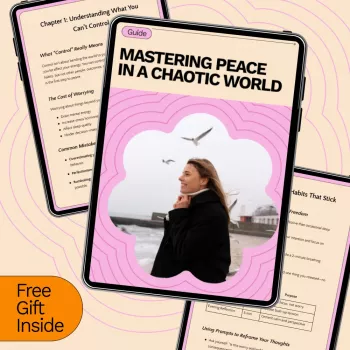
Mastering Peace in a Chaotic World: How to Stop Worrying About Things You Can’t Control
A calm life isn’t built by controlling everything; it’s built by knowing what’s yours to influence, what’s yours to accept, and how to steady your mind when uncertainty shows up. This guide breaks down why worry escalates, how to shift from spiraling to grounded action, and which daily practices make emotional freedom feel realistic—even on noisy, stressful days.
Why worry feels so convincing when life gets unpredictable
Worry can feel productive because it resembles planning. The difference is that planning leads to decisions and actions, while worry often loops without producing anything you can do next. When your brain senses uncertainty, it tends to treat it like a threat—especially when you’re tired, stressed, or consuming constant updates—so it ramps up scanning, rumination, and “what if” thinking.
Another trap: trying to eliminate discomfort can reinforce it. When anxious thoughts are treated like emergencies to be extinguished, they often come back louder. Peace isn’t about never feeling anxious; it’s about recovering faster and responding with intention. For a helpful overview of how stress affects the body, see the American Psychological Association’s resource on stress effects.
The control map: separate what’s controllable, influenceable, and uncontrollable
When worry hits, it helps to label it quickly. Most worries fall into one of three buckets:
- Controllable: personal choices, boundaries, routines, communication, spending, sleep schedule, and how you respond to triggers.
- Influenceable: outcomes shaped by collaboration or timing—relationships, workplace dynamics, family decisions, community issues.
- Uncontrollable: other people’s reactions, global events, the past, random delays, and the fact that uncertainty exists.
Once the worry is categorized, match it to the right response: act (control), influence (ask/coordinate), or accept (release the tug-of-war).
From worry to response: a quick control map
| Worry trigger | What can be controlled | What can be influenced | What must be accepted | Next best step (10 minutes) |
|---|---|---|---|---|
| A loved one is upset | Tone, listening, boundaries | Conversation timing, support options | Their feelings and final choice | Ask one clarifying question; offer one concrete support option |
| Work uncertainty | Quality of work, priorities, updates | Stakeholder alignment, timelines | Company decisions, market shifts | Write a 3-item priority list; send one status message |
| News cycle anxiety | Media intake limits | Community action/volunteering | Events outside reach | Set a 15-minute news window; do one grounding exercise |
| Health worries | Appointments, habits, questions to ask | Second opinions, support system | Perfect certainty | Schedule one step; write down questions for the next visit |
Calm mindset shifts that stop spirals without denying reality
Worry tends to expand time—pulling you into imagined futures that feel urgent and endless. Mindset shifts shrink that expansion without pretending everything is fine.
- Shift from “What if?” to “What now?” Focus on the next workable step rather than the entire imagined future.
- Trade perfection for process. Build a stable routine that can bend instead of a rigid plan that breaks.
- Replace catastrophizing with probability. Ask, “What’s most likely?” and “What evidence supports this fear?”
- Use “both/and” thinking. You can feel anxious and still act wisely; you can dislike uncertainty and still live fully.
- Choose values over moods. Values-based decisions stay steadier than panic-based decisions.
If worry is frequent and intense, it can help to recognize when it edges into an anxiety disorder; the National Institute of Mental Health overview of anxiety disorders offers a clear starting point.
A simple reset plan for the moment worry takes over
When your mind is sprinting, complex advice can feel unusable. This quick reset is designed to be done in real life—mid-email, mid-argument, mid-headline.
Emotional freedom through boundaries, attention, and self-talk
Daily practices that make calm more automatic
If your space is contributing to mental noise, a step-by-step approach can help simplify the environment without turning it into a massive project: One Room, Real Progress: A Simple Step-by-Step Guide for Stress-Free Home Organization.
Using a structured guide to make the changes stick
A focused resource designed around these ideas is Mastering Peace in a Chaotic World: How to Stop Worrying About Things You Can’t Control Guide for Calm, Mindset Shifts, and Emotional Freedom.
To make calm even more “automatic,” many people pair mindset work with practical home systems that reduce daily friction. If you’re dealing with tight quarters or multipurpose rooms, Maximize Function, Minimize Clutter | Multifunctional Room Layouts eBook can support a setup that feels simpler to maintain.
When worry may need extra support
Evidence-based options include cognitive behavioral therapy (CBT), acceptance and commitment therapy (ACT), and mindfulness-based approaches. For additional clinical context, the Mayo Clinic overview of anxiety disorders is a reliable reference. If there are thoughts of self-harm or feeling unable to stay safe, immediate help is important.
FAQ
How can worrying about things outside control be stopped without ignoring problems?
Use a control map: act on what’s controllable, try influence where possible, and practice acceptance for the rest. Pair acceptance with one small next step so the problem is addressed without feeding the spiral.
What’s the fastest way to calm down during a worry spiral?
Slow the exhale to settle the body, label the emotion and trigger, shrink the time horizon to the next workable step, and do one small action to close the loop. Speed comes from simplicity and repetition.
How long does it take to feel more emotionally steady?
Small improvements often show up within days of consistent short practices, while more durable change tends to build over weeks. Consistency and realistic routines matter more than intensity.





Leave a comment