Stage Calm Checklist: Beat Performance Anxiety in 10 Minutes
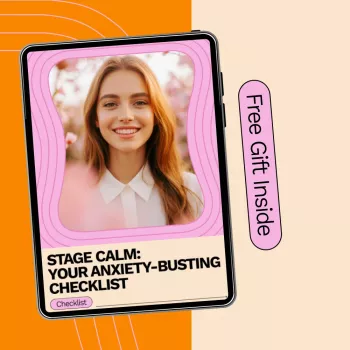
Stage Calm: Your Anxiety-Busting Checklist for Performing with Confidence
Performance anxiety can show up as a racing heart, shaky hands, tight breathing, or a sudden blank mind—right when focus matters most. Stage Calm is a simple, repeatable checklist designed to turn that pre-performance surge into a steady routine, so preparation feels clear and confidence feels reachable. Use it before auditions, presentations, competitions, recitals, interviews, or any moment where eyes are on you.
What “stage anxiety” really is (and why a checklist helps)
Stage anxiety is often a normal stress response: your body prepares for a perceived threat, even if the “threat” is simply being evaluated. When adrenaline rises, attention can narrow, breathing can get shallow, and thinking can become less flexible—making small mistakes feel bigger than they are. (For a helpful overview of how stress affects the body, see the American Psychological Association.)
A checklist helps because it reduces decision fatigue. Instead of debating what to do next (“Should I practice more? Drink water? Pace the hallway?”), the next step is already chosen. Over time, a consistent pre-stage routine trains your brain to associate a sequence of actions with safety and readiness—not danger and uncertainty. Our team built Stage Calm to be used quickly and repeatedly, so the routine becomes automatic when pressure spikes.
How Stage Calm fits into your day (not just the last 5 minutes)
Stage Calm works best in three time windows: the day before, the hour before, and the final minutes before you step up. The day-before portion focuses on lowering baseline stress—sleep planning, hydration reminders, and a realistic run-through that ends early enough to rest. The hour-before portion supports steady energy and focus: a short warm-up, a quick environment check, and a plan for distractions (phone, chatter, last-minute changes).
The final-minutes portion is about regulation: breathing, grounding, posture, and one clear performance intention. If you perform regularly—weekly meetings, ongoing classes, gig sets—Stage Calm becomes a reusable template that prevents last-minute scrambling and makes “show time” feel familiar.
A practical 10-minute pre-stage routine (built from the checklist)
If you’re short on time, use this compact version. The goal isn’t to feel “perfectly calm”—it’s to start steady and give your brain a clear track to run on.
| Time | Checklist focus | What to do |
|---|---|---|
| 0–2 min | Downshift | Slow exhale breathing, relax jaw/shoulders, unclench hands |
| 2–4 min | Ground | 3-2-1 sensory check to anchor attention in the room |
| 4–6 min | Intention | Pick one controllable goal for the start (pace, tone, clarity) |
| 6–8 min | Start practice | Rehearse only the first 10–20 seconds; stop while it’s clean |
| 8–10 min | Commit | Confirm essentials (materials, water, cues), then begin |
Minute 0–2: Reset the body
Lengthen your exhale and let your shoulders drop. Loosen your jaw and soften your hands—two common “panic clamps” that can amplify tremor and tension.
Minute 2–4: Ground attention
Do a quick 3-2-1 check: notice 3 things you can see, 2 things you can feel, and 1 thing you can hear. This anchors you in the room instead of in a future “what if.”
Minute 4–6: Cue confidence with one intention
Choose one simple goal you can control: a clear opening line, a strong first note, or a steady pace. A single intention beats chasing “perfect,” especially when adrenaline is high.
Minute 6–8: Micro-rehearse the opening only
Run just the first 10–20 seconds. This protects the most vulnerable moment—your start—without exhausting your brain by replaying the entire piece.
Minute 8–10: Commit to the first action
Confirm your essentials (materials, water, cues), then step into your first action: breathe, begin. Let the routine be your “green light.”
Common spirals the checklist helps interrupt (and what to do instead)
- Spiral: “If I feel anxious, I’ll fail.” Swap to: treat anxiety as energy; channel it into breathing, posture, and pace.
- Spiral: Over-rehearsing right before going on. Swap to: micro-rehearse the opening only, then rest your brain.
- Spiral: Scanning for mistakes mid-performance. Swap to:
- Spiral: Comparing yourself to others backstage. Swap to:
- Spiral: One slip becomes a collapse. Swap to:
If anxiety feels persistent or overwhelming, it can help to learn more about anxiety symptoms and supports from trusted medical sources like the National Institute of Mental Health or the Mayo Clinic.
Where Stage Calm shines: performers, speakers, students, and high-stakes moments
How to get the most out of the checklist (a simple practice plan)
Recommended tools from our store
- Stage Calm: Your Anxiety-Busting Checklist – Overcome Performance Anxiety with Confidence (a repeatable routine for the day before, hour before, and final minutes)
- One Room, Real Progress: A Simple Step-by-Step Guide for Stress-Free Home Organization (reduce baseline stress by making your practice space easier to use consistently)
- Maximize Function, Minimize Clutter | Multifunctional Room Layouts eBook (build a setup that supports rehearsal flow and fewer last-minute “where is it?” moments)
FAQ
Will Stage Calm stop anxiety completely?
Not always. The checklist is designed to reduce intensity, improve control, and give you a repeatable routine so you can start strong and recover quickly if nerves spike.
How soon should the checklist be used before going on stage or speaking?
Use it in three windows: the day before, the hour before, and the last 10 minutes. When time is tight, the 10-minute quick routine is the most practical way to get regulated and focused fast.
Is this only for performers, or does it work for interviews and presentations too?
It works for interviews and presentations as well. Breathing, grounding, a single intention, a short opening rehearsal, and a clear “commit” step map directly to speaking situations.





Leave a comment